
Powerline spotters who keep plant clear of live lines.
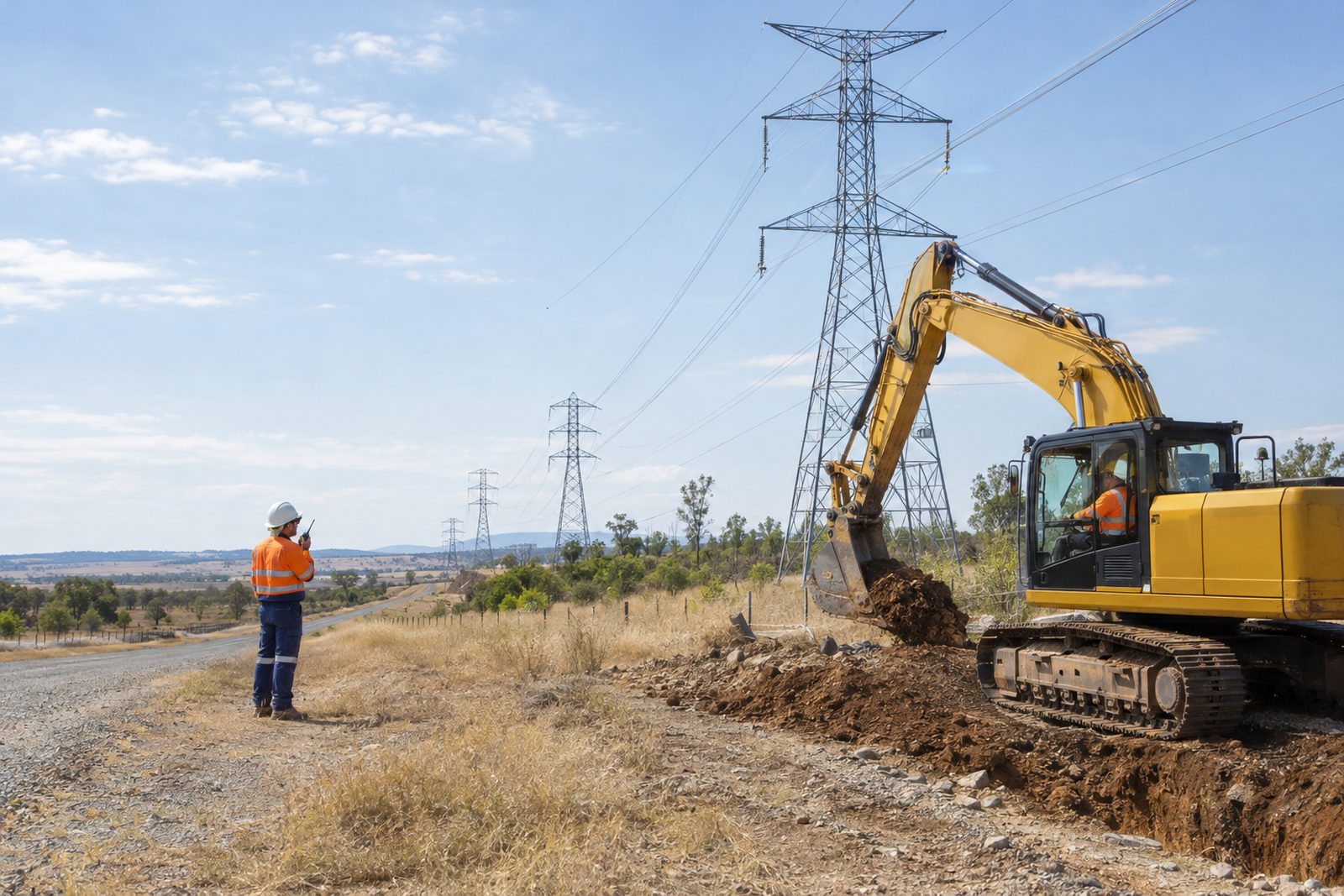
Excavators, tippers, cranes, concrete pumps and elevating work platforms all reach higher than people expect. Our spotters stand where they can see the gap between the plant and the line, and warn the operator early, every lift, every swing, every tip.
One spotter, one item of plant, full attention.
We match spotters to the plant on site and the line type, and position each one to judge the clearance from the side, not from under the boom.
- Dedicated spotting for excavators, tippers, cranes, concrete pumps and EWPs near overhead lines
- Pre-start check of line voltage, exclusion or no go zone distances and the SWMS controls
- Set-out of visual markers, goal posts and ground barriers where your plan provides for them
- Coordination with the network operator's permit, isolation or tiger tail conditions
A shift record you can show an inspector.
Your site and safety team receives a record of every shift, linked to the job and the permit.
- Plant spotted, operator, start and finish times
- Line type, voltage and the clearance distance applied
- Warnings given, stop work calls and near misses
- Photographs and GPS locations of the work area
How pricing works
Quotes are itemised by shift rate, travel, vehicle and equipment, and reporting. Rates are set per spotter per shift, with standby and travel listed separately.
Send the site location, the work program, the plant on site, your preferred dates and any permit or network operator conditions. We confirm scope, availability and price before work is booked.
What a spotter does, and does not do
A spotter has one job: watch the hazard and warn the operator or crew before anyone or anything gets too close. Our spotters do not operate plant, direct traffic as a licensed traffic controller, or take on other site tasks while they are spotting. That focus is what makes the control work.
Spotting supports, and never replaces, the higher order controls in your plan, such as isolation, de-energising, relocation or physical barriers arranged with the asset owner.
Tickets and competencies
Each shift is filled by personnel holding the tickets and competencies the task requires in that state, such as an endorsed spotter or safety observer course, general construction induction, first aid and CPR, and confined space, gas test or heights units where the work calls for them. Copies are supplied with the quote or before mobilisation on request.
Frequently asked questions
When do I need a powerline spotter?
Whenever plant or equipment could come closer to an overhead line than the safe distance for that voltage. The distance and the trigger depend on the state. In Victoria, for example, a registered spotter is needed when earth-moving plant works between 3.0 and 6.4 metres of distribution lines.
Can one spotter watch two machines?
No. A spotter watches one item of operating plant at a time. If two machines work near the line, you need two spotters.
Can a spotter replace an isolation?
No. Spotting is a lower order control. Where plant needs to work inside the exclusion zone, the network operator's permission, isolation or other controls come first.