Overhead powerline spotters
Dedicated spotters for plant working near overhead electric lines.

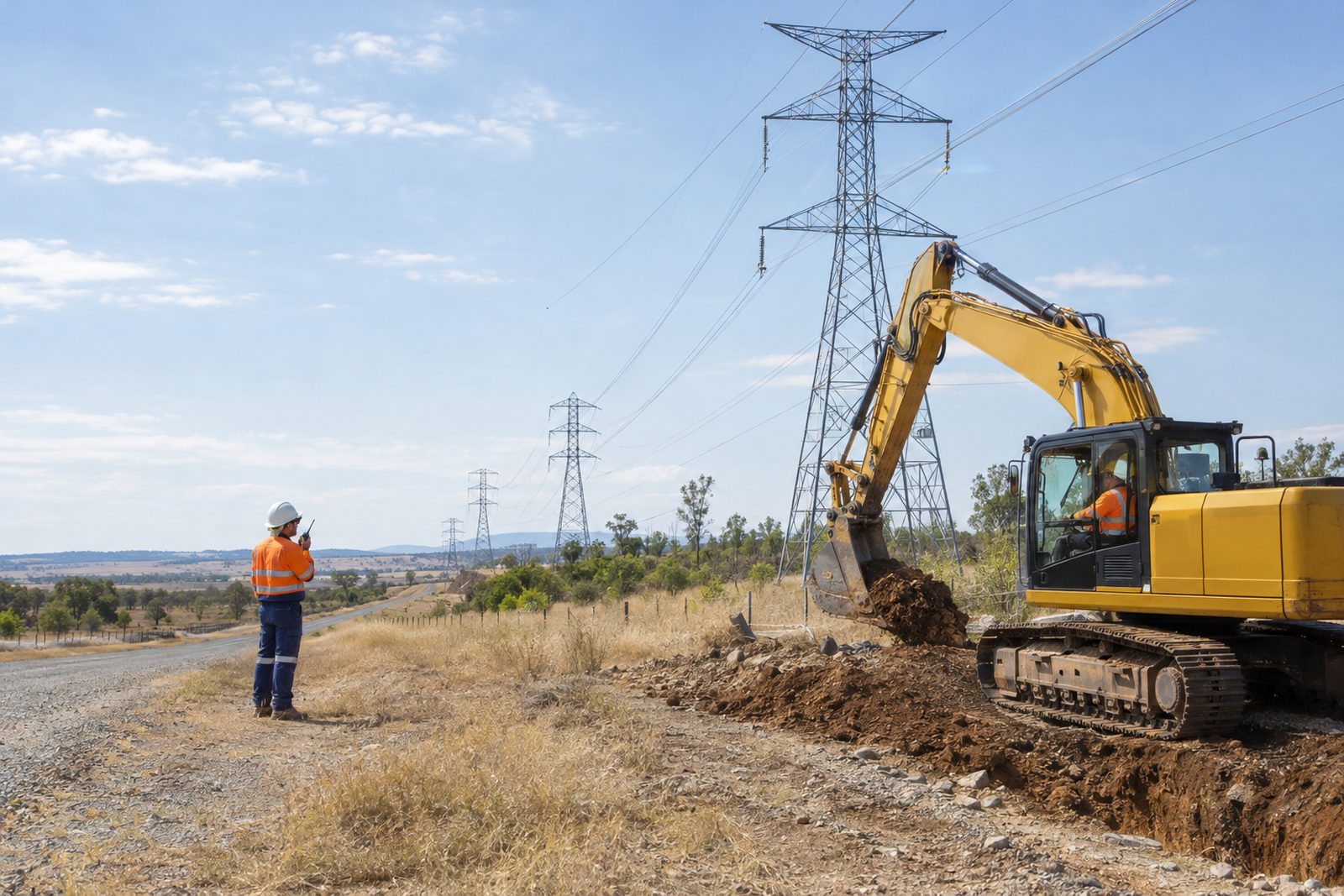
We supply spotters and standby people to projects in Victoria, so plant stays clear of powerlines and buried services, people stay clear of plant, and high risk work has someone watching. Every shift is recorded, and our work follows the Occupational Health and Safety Act 2004 and Occupational Health and Safety Regulations 2017 and the rules for work near electric lines.
Choose a service to see what is included, or talk to us about combining them.
Dedicated spotters for plant working near overhead electric lines.
Spotters beside the trench near buried power, gas, water and fibre.
Spotters for plant, cranes and reversing vehicles on busy sites.
Separation of people and vehicles at gates, crossings and laydown.
Standby people at the entry for pits, tanks, pipes and vaults.
Ground standby and rescue readiness for platforms and height work.
Dedicated fire watch during hot work and the cool down period.
Site walks, zone mark-up and spotter plans before work starts.
Rostered spotter and standby crews with a crew lead on site.
Practical site briefings on lines, services and exclusion zones.
We support transmission, renewables, road, rail and civil projects with registered spotters for each item of plant.
Send the site, the work program, the plant on site and any permit or network operator conditions. We will confirm the scope, crew and price before anything is booked.
Work health and safety in Victoria is covered by the Occupational Health and Safety Act 2004 and Occupational Health and Safety Regulations 2017. Work near electric lines is covered by the Electricity Safety Act 1998 and the WorkSafe and Energy Safe Victoria No Go Zone framework. Under the No Go Zone framework, a registered spotter who has completed an endorsed course is needed when earth-moving plant works between 3.0 and 6.4 metres of distribution lines, or between 8 and 10 metres of transmission lines on towers. Closer than that needs the network operator's permission.
The main network operators are Powercor, CitiPower, Jemena, AusNet Services and United Energy. Only the asset owner can confirm a line's voltage, approve work inside its exclusion zone or arrange isolation. For buried services, Before You Dig Australia plans and an accredited locator come first. Project permits and site rules may add further conditions, and we check them for each job.
Send the site, dates and scope. We confirm availability, travel and inductions before agreeing a start date.
Work health and safety is covered by the Occupational Health and Safety Act 2004 and Occupational Health and Safety Regulations 2017, and work near electric lines by the Electricity Safety Act 1998 and the WorkSafe and Energy Safe Victoria No Go Zone framework. Under the No Go Zone framework, a registered spotter who has completed an endorsed course is needed when earth-moving plant works between 3.0 and 6.4 metres of distribution lines, or between 8 and 10 metres of transmission lines on towers. Closer than that needs the network operator's permission.
Yes. Many projects book powerline spotters, excavation spotters, confined space standby and fire watch together under one quote, which keeps travel and reporting costs down.